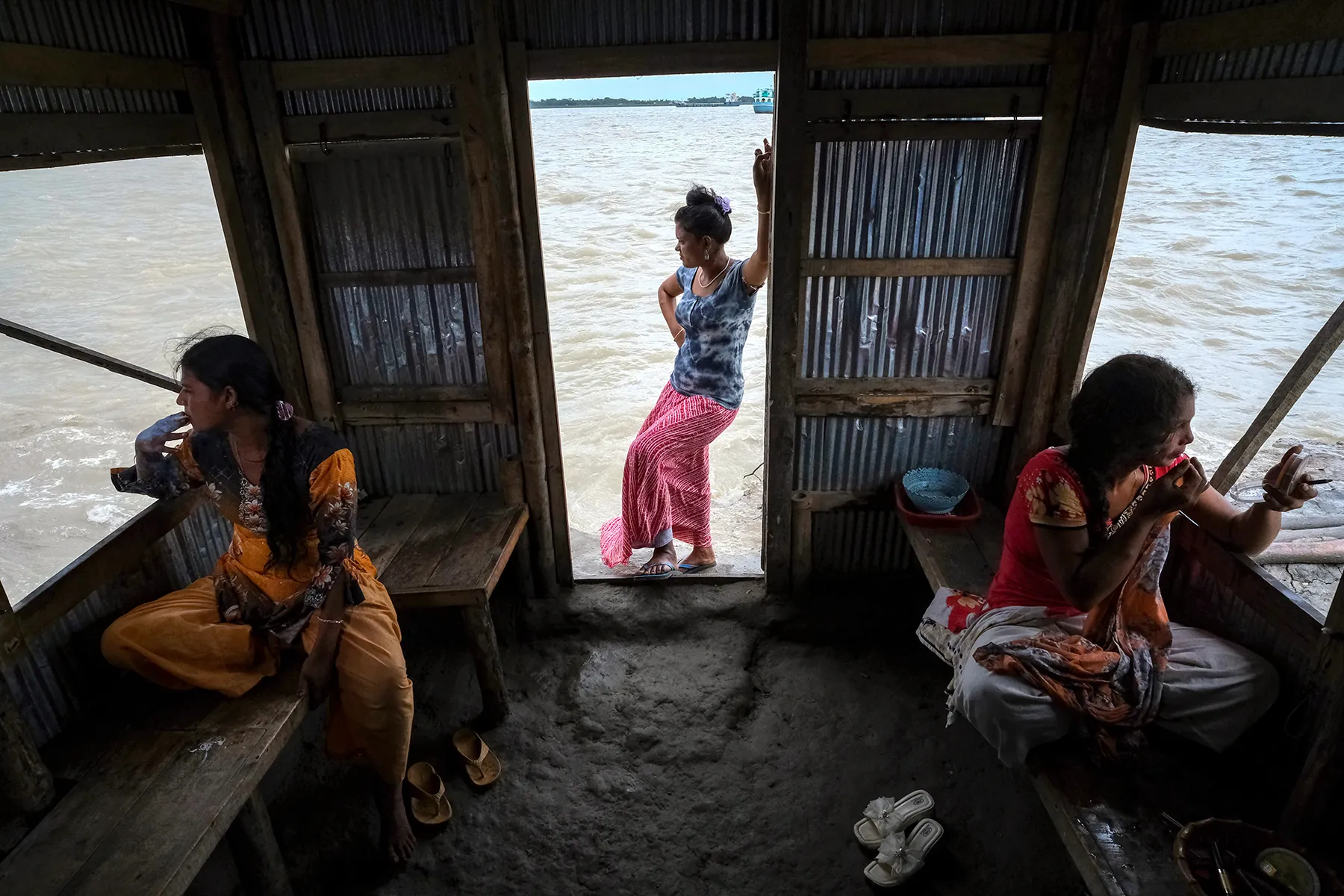
“Shoreline of Survival: Sex Workers at the Frontline of Climate Change in Bangladesh”
Where the river swallows land and homes collapse into water, Baniashanta clings to
existence an aging Brothel carrying the fragile secret of survival. Located on the bank
of the Poshur River near the Sundarbans in Dakop Upazila, Khulna, this government-
recognized brothel was established around 1954. Today, it stands at the frontline of
climate disaster, its history and its women eroded by the same rising tides.
Once alive and vibrant, the settlement has been hollowed by floods, cyclones, and
relentless river erosion. Each storm tears away more ground, each tidal surge pushes
families further into uncertainty. Scientific studies warn that Bangladesh’s coastal belt
faces some of the fastest rates of sea-level rise in the world. Saline intrusion poisons
soil and water, collapsing livelihoods and driving migration. But for those in
Baniashanta, there is no escape. Many women remain, caught between vanishing land
and the unyielding demands of survival. Hunger shapes every choice. To meet clients’
expectations, some turn to drugs, forcing their bodies beyond their limits. Survival here
is not only a battle against the river but also a war within the body itself. Sexual and
reproductive health is fragile, worsened by addiction, malnutrition, and lack of medical
care. Human dignity erodes as quickly as the shoreline.
Beyond the broken walls, the landscape whispers of loss: homes swept away, roots
severed, and security stripped bare. Within shadowed rooms, another story unfolds—
women trading intimacy for food, shelter, or simply a night without hunger. Intimacy
becomes labor; resilience is measured in the quiet accumulation of pain. Every gesture,
every compromise, carries the weight of resistance.
Baniashanta is not only a brothel—it is the intersection of climate change, poverty, and
human rights. Environmental collapse feeds social exclusion. A community stigmatized
for its work is now doubly marginalized by a disaster it did not create. These women,
already pushed to society’s edge, now live on the edge of land itself. Yet amid
devastation, defiance persists like a stubborn flame. Every refusal to vanish is a
declaration that life has value. Baniashanta does not fade quietly; it demands
recognition, dignity, and justice. Its women bear witness to a world that often looks
away. Their survival is a call for urgent humanitarian action. Without immediate
rehabilitation, this community will be erased by the river, its stories and resilience swept
away with the tides.